
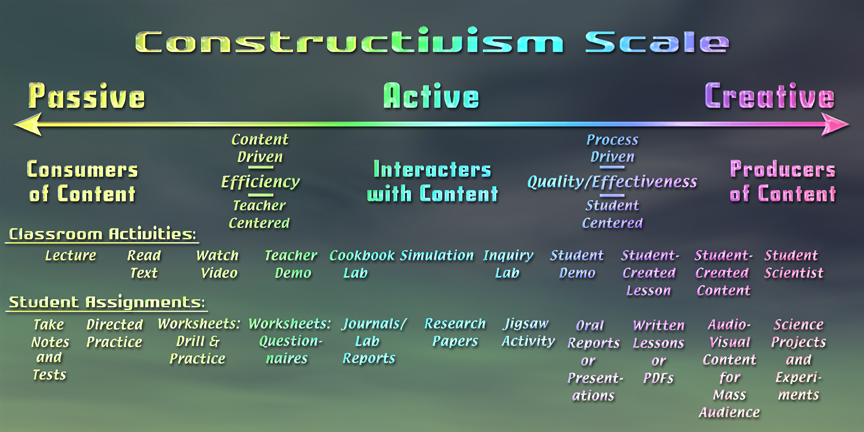
I have been working and re-working a diagram for the last ten years. It was one of the few true insights I’ve gained as a 33-year classroom teacher. In the late 1990s and early 2000s, it was popular in STEM education circles to speak of good science activities as being “hands-on” instead of passive. But it occurred to me one day that perhaps “hands-on” wasn’t the end of the continuum; after all, a cookbook-style lab with pre-digested data and pre-determined results is better than rote-learning, but there are still open-ended inquiries where students become true scientists. It could also go “beyond hands-on” for students to become true creators. Many students start out as passive learners, and it is our responsibility as teachers to provide the kinds of lessons, activities, and practices that will help them move toward becoming creators. I created a nice visual diagram to illustrate this point and wrote a blog post about it (https://elementsunearthed.com/2008/12/02/beyond-hands-on-the-case-for-creative-students/ ).
A few years later I needed to use the original version of the diagram and didn’t have it handy on my computer (or at least couldn’t remember what I’d named it), so I decided to look it up online and download it from my own website. But something unexpected happened: I came upon a different version of my diagram! It had the same content but was a simpler graphic, just black on white. Someone had created their own version, apparently. I looked up the image’s linked website and was astonished to find it as a diagram on education philosophy used by a school in India. Someone had apparently liked it, thought it fit their school’s philosophy, and included it in their parent package of information. Someone out there liked my stuff!
That original version had a title of constructivism at the top, and I have come to understand constructivism much more fully since then. I made some modifications a few years ago and created another version that was more complete. But I have come to see that there is more I should include.
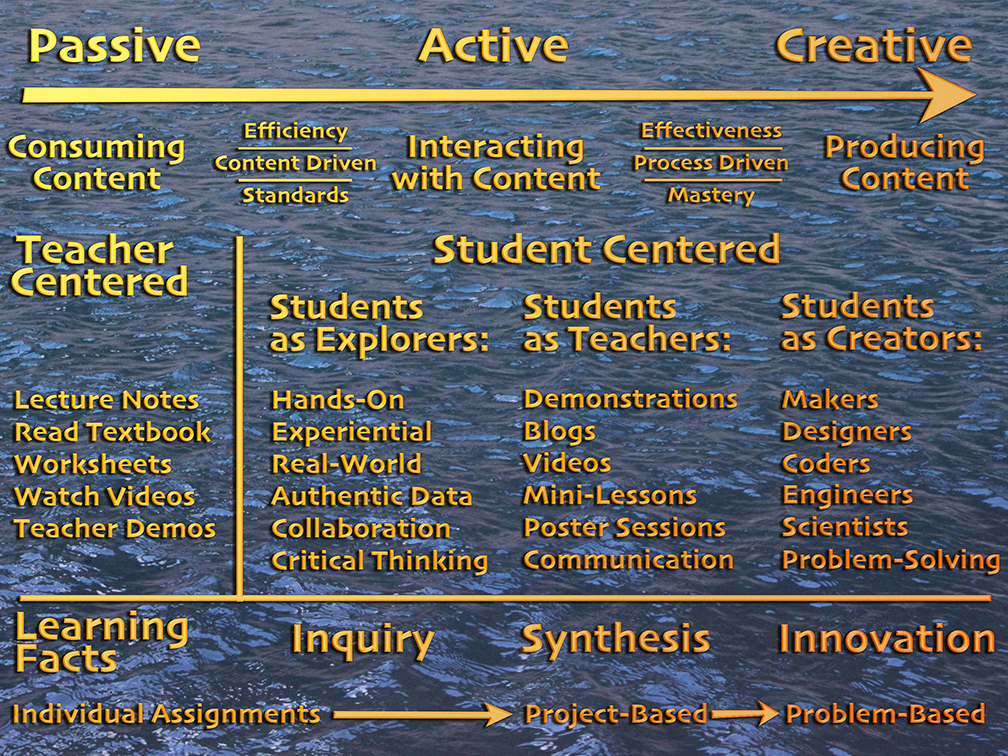
This latest version adds an additional column. Instead of ending at creative, I go further to include a final column for innovative students. Innovation may start with creativity – a new and useful idea – but must contain more skills, such as persistence, resilience, completion, a growth mindset, and a host of other 21st century skills. I also got looking at how each level would be reflected in the kinds of teacher pedagogies, the typical classroom activities used, and the final student outcomes. It contains all of the previous ideas, including putting constructivism in its rightful place, adding in a little Bloom, some 21st century skills, and other insights I’ve gained over the years since the first one was uploaded. It finally feels that everything fits where it was meant to go, even the continuum from instructionism to constructivism to constructionism to social-reconstructionism.
It becomes the duty of education to move students along the model toward becoming innovators as much as possible. That is where they will add the most to society and make the greatest contributions to their own lives. If we look at Bagetto and Kaufman’s 4-C model of creativity, there are four levels: little-c creativity of solving problems in our own person lives all the way up through Pro-c, where your creative solutions become known and accepted within a community of scholars, to the final stage of reaching the wider popular culture through a Big-C creative act. My model follows this framework as well, with classroom activities starting out with a pre-creative passivity and a hands-on stage of Active Learning, where students actively are up and doing, playing sports, dancing, working, acting, and participating, followed by students as creators: makers, coders, teachers, designers, producers, choreographers, playwrights, writers, editors, builders, etc. and finally followed, in all too rare instance, by students as innovators, where they ask questions and conduct experiments to broaden the scope of what’s known and what’s possible in human experience. They change the world, are activists and change agents, solve problems, invent new processes and devices, and become entrepreneurs as they reconstruct society.

My Cosmic Creator Challenge is meant to move students along to the Creative portion of the diagram, from which they can proceed to become innovators. Being creative is student-centered and engaging and is a good place to reach for in K-12 education, but I see now that teaching for innovation is what we should be striving for as teachers as there are still many problems to solve, devices and processes to invent, businesses to start, and questions to answer. And the world could use a little reconstruction.
 The Creative Science Classroom
Leave a comment