
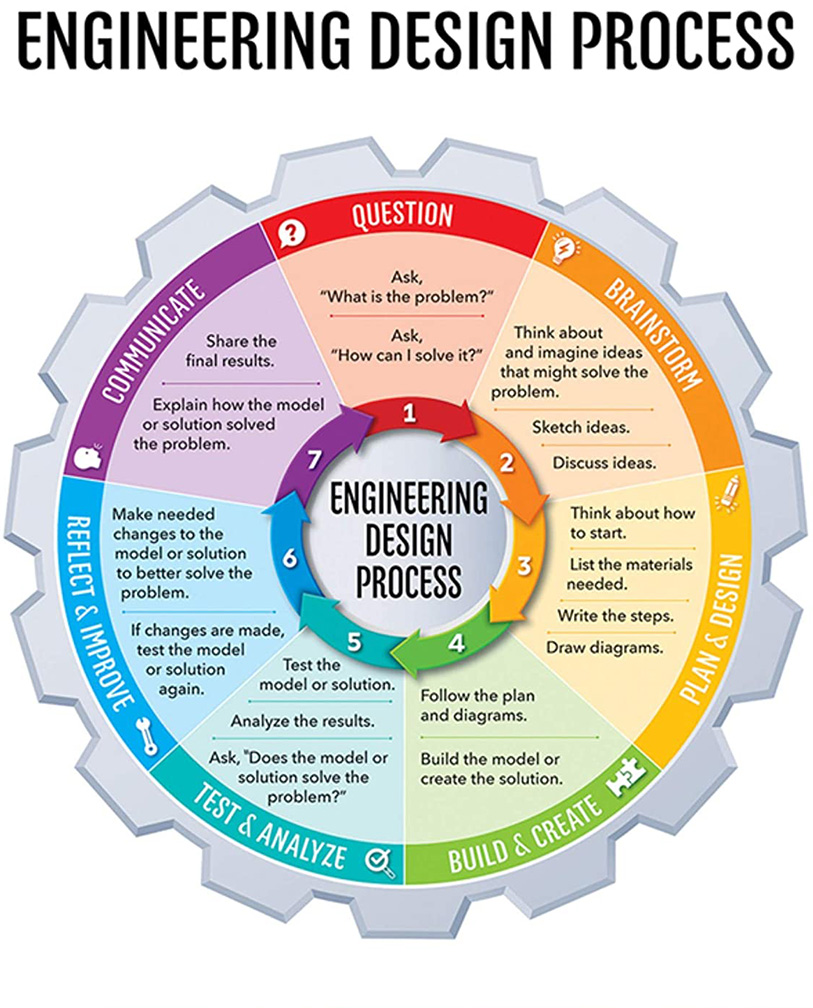
As we approach our second iteration of the Cosmic Creator Challenge, I think it is important to explain one of the fundamental principles of our contest and of my proposed dissertation research. This is the idea of student learning as a form of engineering design with continual revision.
For the Cosmic Creator Challenge, this will be operationalized through students presenting their Challenge projects to at least three peers, essentially teaching them what they learned and how they chose to demonstrate it through the media they created. The students will form teams of four, create their projects individually, but present and improve them together through peer critique and revision. Knowing that their peers will judge their work motivates students to achieve higher quality and not just rush through a project at the last minute. If they try to present a low-quality project, their peers’ evaluations will reflect this and they will have incentive through their low scores and peer suggestions to improve their work. Their projects start as rough drafts or prototypes but become more polished as thy present to peers, to their teachers, and finally get judged by Clark Planetarium’s education staff.
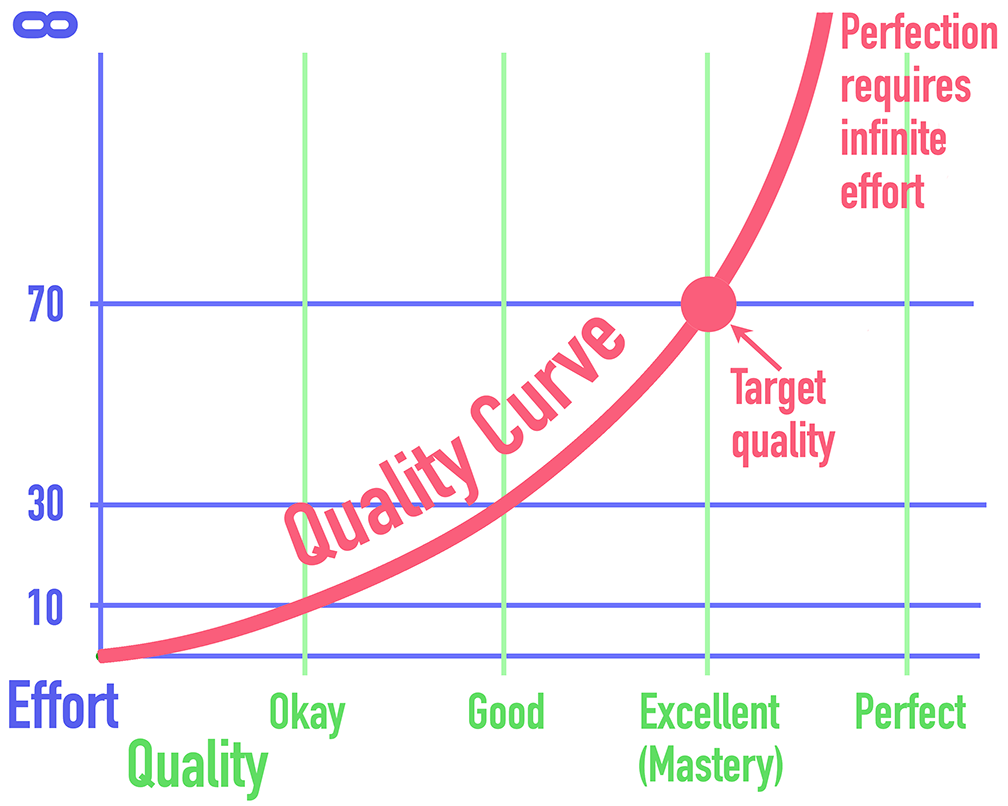
Students have to learn the quality curve as shown here. The relationship between the level of quality of their projects and the amount of effort it takes to reach those levels is not linear. Doubling the effort doesn’t double the quality. It is more of an exponential curve or hyperbola. It takes a certain amount of effort, let’s say 1.0 effort units to get a project to passable, or OK quality (let’s say a C grade). To go from OK to Good takes an additional 4.0 effort units, and from Good to Excellent takes 9.0 more units. The next quality level would be perfection, but the curve is asymptotic to perfection and it would take an infinite amount of effort to reach it. In what is sometimes called the 80-20 rule, it takes 80% of the total time of a project to reach the final 20% of excellence to make the project stand out. In the professional world, good is not good enough.
Some students have such fixed mindsets that they will either become perfectionists who never want to turn in a project and will keep working on it forever, or they will develop learned helplessness and give up early because they know they can’t get it right. The optimal learning level occurs in between, where a student strives for excellence but not perfection. They maximize learning without obsessing over their projects.
Other students are unmotivated to learn (perhaps because of frequent past failures) and will work on a project only to the point that they can turn it in with minimal effort. OK is good enough for them. They comply with assignments only to get the reward of a passing grade or to avoid having their teachers or parents on their case. When they turn in their work, if it is sub-par, they will give up and say “I guess I’m not very smart” when with some revision and a growth mindset, they could achieve excellence and deeper learning. For students at the optimal learning level, an assignment isn’t done just because its been turned in; they welcome feedback with the goal of mastery learning, with continual revision until expectations and learning objectives are fully met. This is excellence.
I think of education as engineering. The purpose of engineering is to identify and solve problems (for science it is to answer questions). Once a problem is identified, engineers will determine a set of specifications for what a successful solution must achieve. Then, engineers will design and build a prototype, or a first-level approximation of the desired solution. This prototype will be tested, then revised, then tested again until it meets the specifications. Sometimes it requires going back to the drawing board, sometimes only minor fixes.
Education should work the same way but often doesn’t. Traditionally, in the instructionist scientific management model proposed by Bobbit (based on Frederick Winslow Taylor’s time-and-motion studies for assembly lines) and still used in far too many schools, teachers provide instruction to all students in the same way as efficiently as possible to get through the most content in the shortest time. It would be like engineers building a prototype and saying its good enough even if it doesn’t work. We push students along even if they don’t understand the content and don’t have the foundational skills because its all done lock step and taught to the lowest common denominator. Schools are assembly lines and students merely raw materials to be stamped into identical final products – the high school graduate. There is very little quality assurance involved, and certainly no customization.
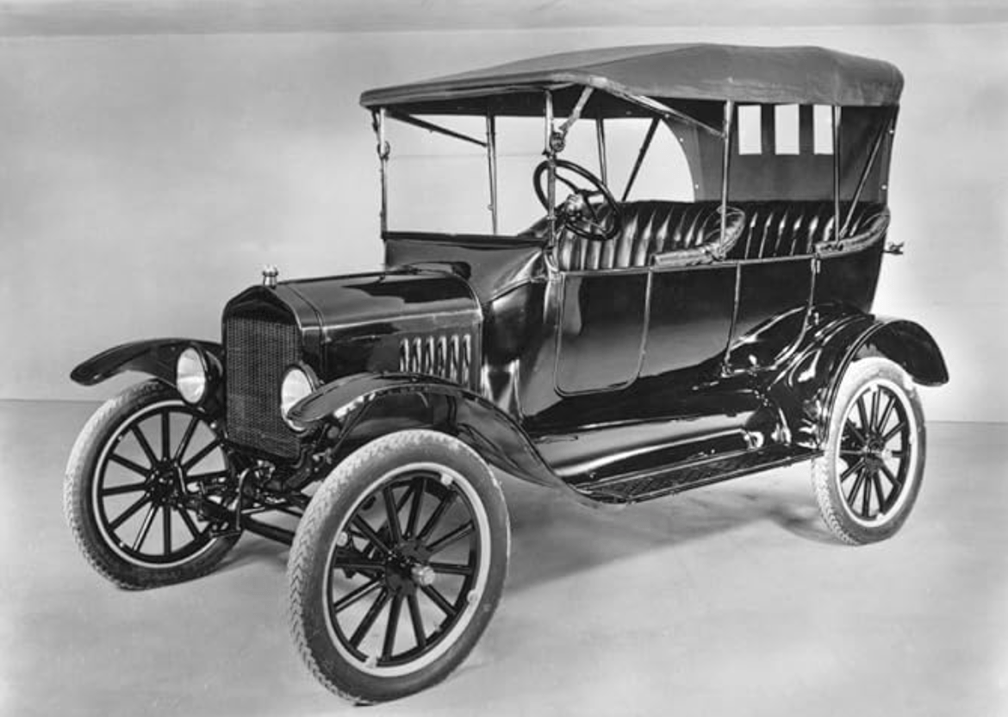
As Henry Ford said about the Model T: you can get any color of Model T you want as long as it’s black. You can get any high school graduate you want as long they are average white kids with average IQ scores and average skills. When American car manufacturers were losing out to the Japanese car makers in the 1970s, it was the same general problem that education has now: lack of quality assurance and no customization.
Imagine what schools would look like if we did treat education like an engineering challenge. In engineering, there are many possible solutions and no right answers. Products are always a work in progress, receiving customer feedback leading to the creation of new versions. Why can’t students be considered works in progress, with Child 1.0 improved to Student 2.0 improved to Adult 3.0 through continuous revision and modification? All students must meet the specifications, all students must master the expectations and standards, but there are many ways to get there. Each successful student is a unique one-of-a-kind production and education is customized to meet each person’s needs.
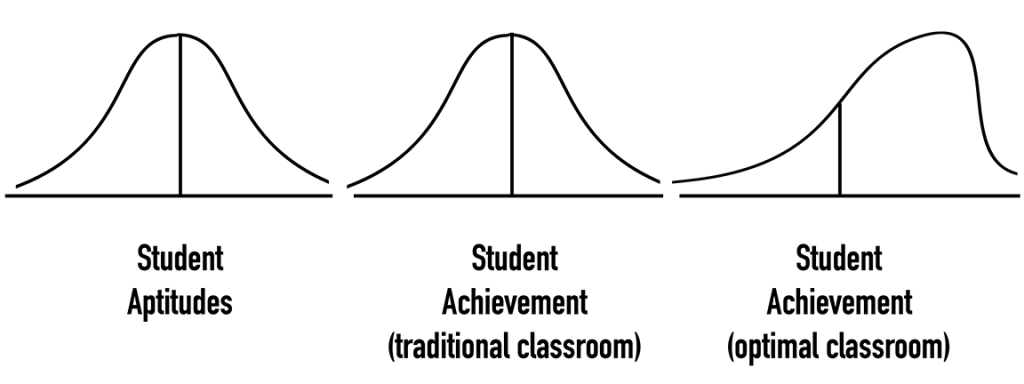
Traditional education treats students as aggregates, as averages. It assumes students fit under a bell-shaped Gaussian curve. But there is no such thing as average – it is merely a construct we use and try to fit students into, to easier teach to the aggregate when we know that each student is unique. Our education should reflect that understanding. More will be said of this in a future post.
The Cosmic Creator Challenge is designed to be customized to meet each students’ skills, learning styles, and interests. Feedback with continuous improvement is built into the process, and students at different skill levels can be successful. One of my goals for this contest is to enhance students’ resilience and support growth mindsets by asking students to revise their projects based on peer evaluations that are kind, specific, and useful.
We are beginning to recruit teachers for the Fall 2024 contest. I hope you consider registering your students and welcome the chance to engineer some education.
 The Creative Science Classroom
Leave a comment