

Welcome to this website! I am David V. Black and this site is dedicated to teaching creativity in science classes. It will host a series of links to videos I am posting on my YouTube channel on creativity and science education, project-based learning, and using browser-based media design software for student created science content. I hope to post at least one blog per week on these subjects along with examples of how my science students have developed their own science media projects.
The Next Generation Science Standards do not say very much about creativity in science education. There is a brief mention about the need for innovation in the Appendix on engineering practices, but otherwise nothing is said. Yet creativity is an essential trait of a successful scientists. To discover new truths, design new experiments, or engineer new products based on scientific principles requires a creative imagination, a spirit of discovery and intuition that will lead to new insights into the natural world.
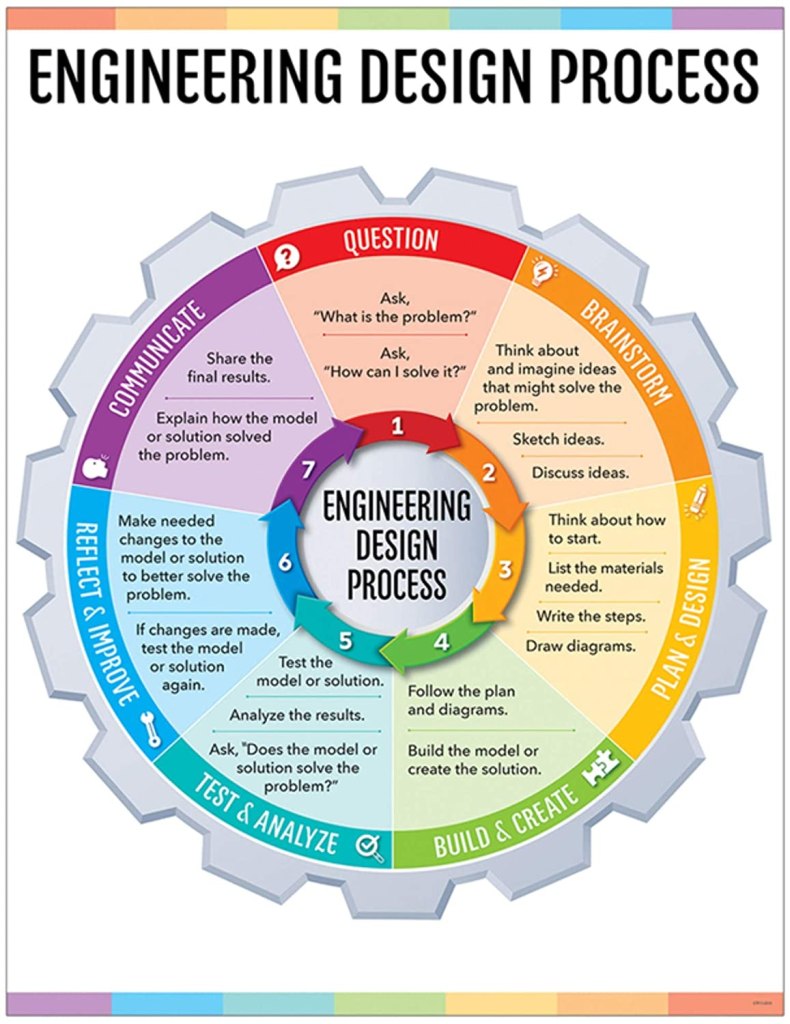
All scientific inquiries lead to challenges, stumbling blocks, and setbacks. To resolve these problems requires a problem-solving mindset to define the problem, think of possible solutions, choose the best idea, design a prototype, and test and revise it until it meets desired specifications to solve the problem. This is the core of engineering design.
Often in order to collect data for scientific inquiry, new instruments must be designed and tested. Take, for example, an instrument such as the Mars Orbiter Laser Altimeter (MOLA) instrument on the Mars Global Surveyor space probe. As the probe orbited Mars, MOLA sent a stream of microwave laser beams toward the surface and timed how long it took the beams to return to the probe’s detector. The longer the time, the further away the surface was. From this data a three-dimensional map of Mars was developed over repeated passes. I have used this data in my astronomy and physics classes, teaching students how to download, use, and apply the data to create their own 3D prints of the surface of Mars. Similar data is available for most of Earth using the Shuttle Radar Topography Mission (SRTM) data available on the USGS EarthExplorer website.
The team of scientists and aerospace engineers who developed the MOLA instrument had to use imagination, creativity, problem-solving, and resilience to overcome obstacles and create an instrument that could handle the stress of launch and the rigors of space while returning useful data. Without these essential components, their innovation would not have happened.

We live in an innovation-driven society. We face a large set of difficult challenges ranging from the ravages of climate change to deforestation and species extinctions, from pandemics to poverty and starvation, from lack of potable water to the spread of deserts. These problems are going to require the combined creativity of current and rising generations to solve.
Yet we do not do a good job at teaching creativity. We agree that it is essential, yet we somehow seem to think students will just acquire it magically sometime during college or adulthood. This is not a correct assumption. What we do not teach for will not happen.
This website is therefore dedicated to bringing creativity into science education, where it is sorely needed. It will also serve as a platform for sharing research and ideas from my doctoral dissertation research. I have completed all coursework for a Doctor of Education (Ed.D.) degree from the University of Northern Colorado and am ABD: All But Dissertation status.
In my next blog post I will introduce you to my dissertation thesis and theoretical and conceptual frameworks and the types of teaching pedagogies I am employing as I bring project-based learning and student media design training to science teachers.
Thank you for joining me. I welcome your comments and suggestions. My email address is: elementsunearthed@gmail.com or you can comment on these posts.
 The Creative Science Classroom
Leave a comment